

By innovation-sa on March 29, 2026 in Office Space
Choosing the right workspace in Saudi Arabia is a pivotal decision for new businesses, especially as Saudi Vision 2030 drives a surge in commercial demand. This strategic choice often drives down to two distinct paths: a serviced office in Saudi Arabia or a traditional commercial lease.
As the economy diversifies beyond oil, major hubs like Riyadh, Jeddah, and Dammam are seeing a radical shift in how real estate is consumed. For a startup or a foreign entity entering the market, the decision impacts everything from initial liquidity to long-term operational agility.
What is a Serviced Office Model?
A serviced office, often located within a business center office for rent in Saudi Arabia, is a plug-and-play solution. These spaces are fully managed by a third-party provider, offering immediate occupancy.
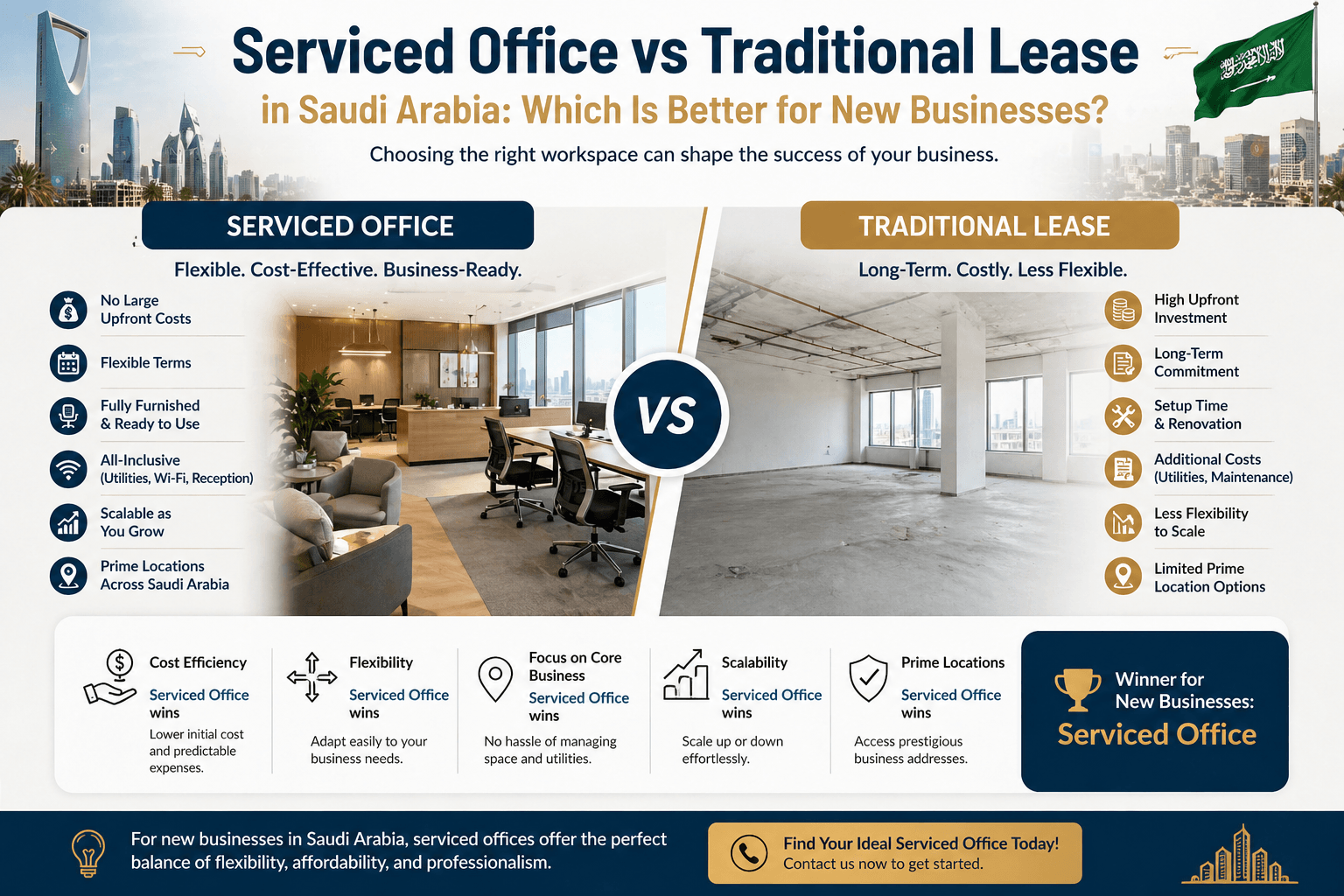
- CAPEX vs. OPEX: Serviced offices shift high upfront Capital Expenditure (CAPEX) into predictable monthly Operational Expenditure (OPEX).
- All-Inclusive Nature: The monthly rent typically covers utilities, high-speed internet, maintenance, cleaning, and reception services.
- Immediate Start: Businesses can be operational within 24 to 48 hours of signing a contract.
- Shared Amenities: You gain access to high-end boardrooms, breakout zones, and kitchen facilities without paying for the total square footage of those areas.
What is The Traditional Lease?
A traditional lease involves renting a shell and core or semi-fitted space directly from a landlord. While it offers maximum control, it comes with significant structural responsibilities.
- Ejar Registration: All traditional leases must be registered through the Ejar platform, a government-mandated system that standardizes contracts and protects both parties.
- Customization: You have the freedom to design the office to reflect your brand identity and corporate culture.
- Long-Term Commitment: These leases generally span 3 to 5 years, requiring a stable five-year business projection.
- Hidden Costs: Beyond the headline rent, tenants are responsible for fit-outs, IT infrastructure, municipality fees (Baladiya), and ongoing maintenance.
Financial Comparison: Upfront vs. Lifecycle Costs
For an office space for new business in Saudi Arabia, cash flow is important.
Initial Investment
In a traditional lease, the tenant often pays for:
- Fit-out costs: These can range from SAR 2,000 to SAR 5,000 per square meter depending on the luxury level.
- Security Deposits: Usually 10% to 20% of the annual rent.
- Brokerage Fees: Typically 2.5% to 5% of the first year’s rent.
Conversely, a serviced office requires only a small refundable deposit (usually 1-2 months) and the first month’s rent, making it the superior choice for capital preservation.
| Feature | Serviced Office | Traditional Lease |
| Initial Setup Cost | Very Low (Refundable Deposit) | Very High (Fit-out + Furniture) |
| Contract Length | Flexible (Monthly/Yearly) | Long-term (3–5 Years) |
| Furniture & IT | Included | Tenant’s Responsibility |
| Utility Bills | Included in Rent | Separate Monthly Payments |
| Speed to Market | Instant (Plug-and-Play) | 3–6 Months (Fit-out period) |
| Brand Identity | Limited to signage/door | Total Creative Control |
Operational Agility and Scaling
In the fast-paced Saudi market, the ability to pivot is essential.
- Flexible office space in Saudi Arabia allows you to add or remove desks as your team grows. If you hire five new employees in Riyadh, you simply move to a larger suite within the same business center.
- In a traditional lease, if you outgrow the space, you may be stuck in a multi-year contract with heavy penalties for early termination. Conversely, if you have excess space, you are essentially paying for dead square footage.
What Are The Regulatory and Compliance Requirements
Saudi Arabia has specific regulations that impact office selection:
- CR Requirements: To obtain a Commercial Registration (CR), you must provide proof of a physical address. Both serviced offices and traditional leases are accepted, provided the provider is properly licensed.
- Foreign Investment (MISA): For foreign companies under MISA licenses, having a reputable physical presence is often a prerequisite for banking and visa processing. A serviced office in Saudi Arabia provides an immediate verified address to satisfy these authorities.
Which is Better for Your Business Stage?
Serviced Offices
- Ideal for testing the Saudi market without a heavy capital commitment.
- Perfect for consultants or contractors working on specific Vision 2030 gigaprojects.
- Allows founders to focus on product-market fit rather than managing plumbing or internet outages.
Traditional Leases
- Companies with 50+ employees who require specific security protocols or bespoke branding.
- If your headcount is predictable for the next 5 years, the lower per square meter cost of a traditional lease eventually offsets the initial fit-out CAPEX.
Strategic Location: Riyadh, Jeddah, and Beyond
The demand for flexible office space in Saudi Arabia in specific districts:
- Riyadh: The King Abdullah Financial District (KAFD) and Olaya remain the hotspots.
- Jeddah: The Corniche and Tahlia Street are preferred for their accessibility.
- Eastern Province: Dammam and Al Khobar serve the industrial and energy sectors.
Why Do You Need To Choose Innovation SA?
Choosing between a serviced office vs traditional lease in Saudi Arabia depends on your risk appetite and growth stage. For most new businesses, the pay-as-you-grow model of a serviced office offers the necessary protection against market volatility while providing a professional environment to attract local talent.
Navigating the Saudi Arabian commercial landscape requires local expertise and strategic foresight. At Innovation SA, we specialize in empowering new businesses to find their footing in the industry.
From licensing support to help you identify the perfect office space for new business in Saudi Arabia, we ensure your entry into the market is seamless and compliant with Vision 2030 standards.
Contact Us Today
Ready to scale your business in the Middle East? Whether you need a flexible office space in Saudi Arabia or help navigating the legalities of a traditional lease, our team is here to guide you.
FAQ
- Can I use a serviced office address for my Saudi Commercial Registration (CR)?
Yes, most premium serviced office providers are licensed to provide the necessary documentation (including Ejar) required by the Ministry of Commerce and MISA for CR issuance.
- Are utilities like electricity and water extra in a serviced office?
No, one of the primary benefits of a business center office for rent in Saudi Arabia is that utilities, cooling, and even high-speed internet are included in the single monthly fee.
- Is it possible to customize a serviced office with my company logo?
While you cannot move walls or change flooring, most providers allow for door signage and minor internal branding to maintain a professional identity.
- What is the minimum lease term for a traditional office in KSA?
While some landlords may negotiate, the standard for commercial properties is typically 3 years.
- How much can I save upfront by choosing a serviced office?
By avoiding fit-out costs, furniture procurement, and IT setup, a new business can save anywhere from SAR 100,000 to over SAR 1,000,000 in initial CAPEX, depending on the office size.